
Where Consciousness, AI, and Time Converge: Calvin Engen on The Infinity Formula

In this month’s Author of the Month interview, Calvin Engen discusses the unexpected moment that sparked the book, his evolving ideas about consciousness and AI, and why he believes humanity’s technological future also calls for greater awareness, purpose, and intention.
The ideas expanded beyond that initial experience into questions about technology, artificial intelligence, existence, and our relationship to the source of it all.
Calvin Engen
The Infinity Formula begins with what you describe as a single deliberate thought that eventually grew into an entire way of understanding consciousness, time, technology, and existence. Do you remember the moment that idea first took hold, and when did you realize it could become a book?
I recall it vividly. I was sitting on the couch watching a movie with my wife when my mind began to wander. I became aware of my own thoughts, observing them and almost feeling them as they unfolded. As I paid closer attention, time seemed to slow down.
Then this profound thought came rushing through my consciousness. Thought is unfolding through time, and consciousness is the experience of that unfolding. I grabbed a piece of paper and began writing what would become the formula. I was trying to capture this relationship between consciousness, time, and the universe, with an acceleration happening around us and through us toward infinity.
I left the paper in my office and returned to it the next morning. What stayed with me wasn’t just the equation, but what it might mean. Over the next couple of weeks, I carried that piece of paper with me and began exploring human experience and the progression of humanity through this lens.
Eventually, I felt I needed to share it, as if I’d opened something that could not be contained. I didn’t initially know what form that would take, but as I built an outline and began writing, it became clear that it was becoming a book.
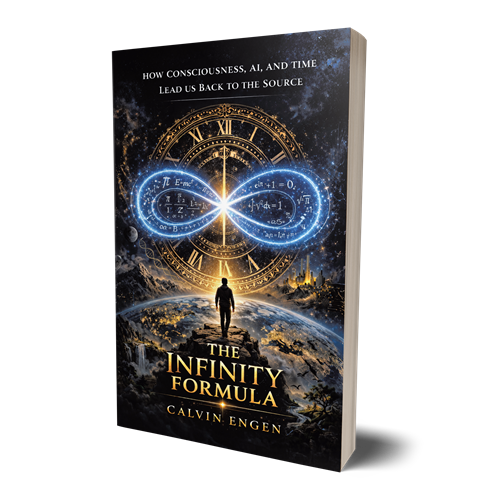
At the centre of the book is the formula U=S(C×T)A→∞U = S(C × T)^A → ∞. For someone encountering it for the first time, how would you explain what the formula represents—and why was an equation the right metaphor for these ideas?
The Infinity Formula is a lens to look through and live into. It brings together the book’s central ideas, the Source, consciousness, time, and acceleration, and explores our experience of the universe as an unfolding movement toward infinity.
For me, its value is in how you experience those ideas. What happens when you become more conscious of your thoughts? How does that change your experience of time? How do you find connection and meaning in a world that keeps accelerating?
The idea first came to me as an equation, so sharing it in that form felt natural. It gave me a foundation to build from and a thread for readers to follow throughout the book. It isn’t an equation to solve. It’s an invitation to explore.
You make an important distinction early in the book that terms such as “simulation,” “Source,” and even the formula itself are philosophical lenses rather than scientific claims. Why was establishing that distinction so important to you?
I wanted to be clear about what I was offering and make the book accessible. Words like “simulation” and “Source” can carry strong associations. They can create curiosity, but they can also cause someone to feel that they’re being asked to accept a particular belief.
My intention is to offer a perspective that readers can explore through their own experience. Being clear that these are philosophical lenses gives people room to question, reflect, and decide what resonates with them.
I wanted the book to open a conversation. Readers should be able to engage with its ideas without feeling they have to agree with every part of them.
Artificial Intelligence occupies an unusual place in the book: it’s part of humanity’s technological acceleration, but you also describe AI as a kind of mirror. What do you think AI is revealing to us about human consciousness and about ourselves?
When I describe AI as a mirror, I’m thinking about how much of humanity we encounter in it: our language, knowledge, creativity, contradictions, and biases. We’re creating something from the traces of human thought, and then engaging with those reflections in a new way. After all, most if not all large language models are trained on human content.
That experience raises deeper questions. What does it mean to understand something? What is the difference between producing an answer and having a lived experience? What gives our thoughts meaning?
I don’t see that mirror as proof that AI is conscious—it’s more of a mimic in it current form. I see it as an opportunity to pay closer attention to our own consciousness and to what we value about being human.
AI also reflects our intentions through the ways we choose to use it. As technology accelerates, those choices matter. For me, the question becomes, How consciously are we participating in what we’re creating, and what do we want to carry forward?
Were there any moments during the Tellwell process, whether through editing, design, formatting, or working with the team, when you saw the book differently or made a decision that ultimately strengthened the finished work?
The editing process was the most valuable part for me. It took the greatest amount of time and reflection, but it helped me bring the manuscript closer to what I intended the book to be.
When you’ve spent so much time with an idea, you carry context that the reader doesn’t yet have. Editing helped me look more closely at that gap, at where I needed to slow down, make cuts in repetition to improve the flow, clarify a thought, or give an idea more room to breathe.
I wanted to preserve the reflective, poetic quality of the writing while making the journey easier to follow. That balance strengthened the book and helped me understand that clarity is part of how you honour the original idea.
Now that you’ve gone through the process from manuscript to published book, what advice would you give another author considering working with Tellwell, or simply preparing to publish a complex, deeply personal book of their own?
Take your time. Give yourself space to step away, reflect, and return to the manuscript with fresh eyes. Especially with a deeply personal book, it helps to put yourself in the reader’s position and ask whether the words on the page carry what you’re trying to share.
Be open to feedback and clear about what matters most to you. Working with an editor is an opportunity to understand your own work more deeply and help it reach someone else.
And eventually, trust yourself enough to let it go. You can keep refining forever, but there comes a point when you recognize that the book says what you needed it to say. Trust that moment and let readers begin their own experience with it.


