
A leading voice in harm reduction challenges the fear-driven narrative around vaping and explains why science, not stigma, should guide public health.
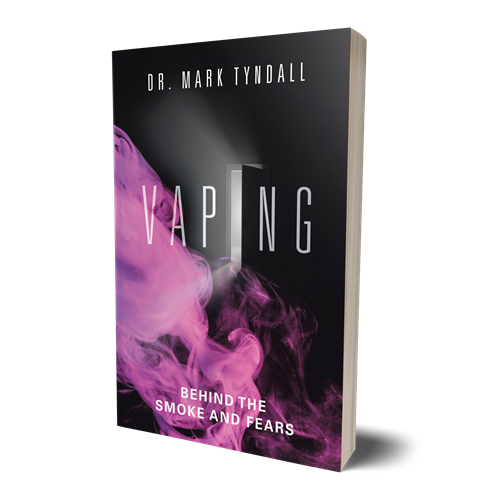
Dr. Mark Tyndall has spent decades on the front lines of public health, supporting marginalized communities and making advancements in harm reduction. In this candid interview he discusses his latest book, Vaping: Behind the Smoke and Fears, which makes the case for vaping as a misunderstood but potentially life-saving alternative to smoking. Drawing from his extensive medical and research background, Tyndall unpacks the myths, media narratives, and policy failures that continue to cloud public understanding, and explains why embracing safer nicotine options could be one of the most important public health shifts of our time.
Most campaigns against vaping are just not truthful or based on science. They are based on fear and stigma.
Dr. Mark Tyndall
Your career has spanned infectious diseases, public health, and harm reduction. What first drew you to focus on tobacco harm reduction and the potential of vaping?
My medical career has really revolved around HIV prevention and care. When I started medical school in 1982, HIV was just emerging as a curious disease among gay men. No one anticipated a global pandemic that would claim over 40 million lives. At the beginning, there was no treatment for HIV and prevention was the only option. Even today, when effective treatment exists, preventing HIV transmission is a global priority. I worked with groups that were particularly vulnerable to HIV transmission: heterosexual couples in sub-Saharan Africa, gay men, women who sold sex, and people who injected drugs. It was clear that sex and drugs could not be stopped and the only way forward was to provide options that would reduce but not eliminate the risk: education, condoms, clean needles, for example. This is harm reduction. So with that background it was pretty clear to me that vaping was a very effective harm-reduction intervention with global implications. Taking the world’s most deadly activity—smoking cigarettes—and offering a much safer alternative: vaping nicotine.

In Vaping: Behind the Smoke and Fears, you describe vaping as one of the most significant public health breakthroughs of our time. What do you believe are the biggest misconceptions about vaping today?
I have taken a deep dive into the subject over the past few years and it is hard to list the biggest misconceptions because there are so many. Sometimes I think there must be a massive conspiracy to protect cigarettes. It is irrefutable that cigarettes are massively more harmful than vaping nicotine. There is no reasonable argument to the contrary. However, most people believe that vaping is just as harmful as cigarettes and public health authorities have been reluctant (or negligent) to correct this misconception. So that would be the number-one misconception. The second is that there is a youth epidemic of vaping that is very harmful. While there has certainly been a lot of young people experimenting with vaping over the past 10 years or so, this peaked in North America around 2018 and has been falling since then. The proportion of young people who now vape daily or who would be considered to be dependent on nicotine is quite low and certainly less than the number of young people who would be smoking cigarettes. This should be seen as a public health win. In addition, there have been very few adverse health effects reported and not a single death from vaping nicotine. The third main misconception is that this is an attempt by Big Tobacco companies to addict a new generation to nicotine. This is far from the truth. Tobacco companies are quite happy selling cigarettes. Although they see a gradual decline in richer countries, the global market continues to produce massive profits and vaping is disruptive to their industry. They are quite happy to have government policies slow down the evolution of safer nicotine products.

You’ve argued that public health policies on vaping have been shaped more by fear and ideology than evidence. Why do you think so many health organizations and policymakers resist embracing vaping as a harm-reduction tool?
This blows my mind. It is entirely irrational. The tobacco control “industry” has been working on abstinence-based approaches to cigarette smoking for decades. They have supported the use of nicotine patches and more recently nicotine gums and sprays, with the goal of eliminating cigarettes. However when vaping came along, they didn’t know what to do. It looked a lot like smoking and it went against the abstinence messaging. They then turned their attention to nicotine addiction and started to vilify nicotine. Agencies that are into tobacco control now talk mainly about nicotine addiction as a reason for restricting vaping. They have also focused mainly on youth which is really a distraction from the main goal of eliminating combustible tobacco and saving the lives of people who currently smoke. They are so entrenched in their abstinence-based world they see no way out.
What role do you see misinformation campaigns and media narratives playing in shaping public perceptions of vaping, especially around youth use?
It is currently out of control. Most campaigns against vaping are just not truthful or based on science, they are based on fear and stigma. They are not particularly effective to dissuade youth from vaping but have created a lot of uncertainty in general. These youth campaigns are a big reason that adult smokers are reluctant to switch to a much safer product. They also create panic among parents who are at the forefront of demanding unreasonable restrictions on vaping products.
Looking ahead, what policy changes or public health initiatives would you most like to see implemented to advance the conversation around vaping and save lives?
I think that eventually a more rational approach will emerge, but unfortunately it is likely to take some time. Obviously, the availability of safer products should be made easier than cigarettes. So there should never be policies that make cigarettes more attractive than vaping. There should be places where vaping is allowed but not cigarettes. Taxes should be much lower on vaping products. Flavours should be widely available for vaping liquids. The promotion of vaping should include relative risk information comparing it with cigarettes. There should be national smoking cessation targets using vaping and safer nicotine products to reach those goals. A smoke-free society is what we are striving for. Not a nicotine-free society.
For readers who may be skeptical about vaping or unsure what to believe, what’s the single most important takeaway you hope they get from your book?
I am always confronted by people who are skeptical or unsure. As a physician I have no problem with patients asking questions about my decisions in their care. In fact I encourage it. I want people to feel confident that if I recommend a certain diagnostic test or order a certain medication, that I have done my homework and have experience dealing with similar illnesses. I don’t take this lightly. But my experience with vaping is very different. Although I am an expert in harm reduction and know a lot about the deadly impact of cigarettes and the relative safety of vaping nicotine, I am constantly faced with skepticism and push-back. I hope that the book can convince people that vaping and safer nicotine products present a major breakthrough for public health and can start to reverse a century of tobacco-induced devastation to human health. At an individual level I hope that this book can convince people who smoke that there are now far better options. They don’t have to die just because they use nicotine.