Award-winning fantasy author explores pacifism, unintended consequences, and the living worlds that emerge when characters take control of the story.
In this month’s interview, we speak with Peter Gribble about the experiences that first inspired the City of the Magicians series, his unconventional approach to fantasy storytelling, and the surprising ways characters can take control of a narrative. We also discuss the challenges of worldbuilding, the creative process behind a growing series, and the publishing journey that transformed a lifelong writer into an award-winning author.
I drew maps, invented their glyphic script and created family histories. Writing improved the information. Items became essential plot devices, spawning fresh arcs. As the story unfolded, everything drew together into a living, seamless whole.
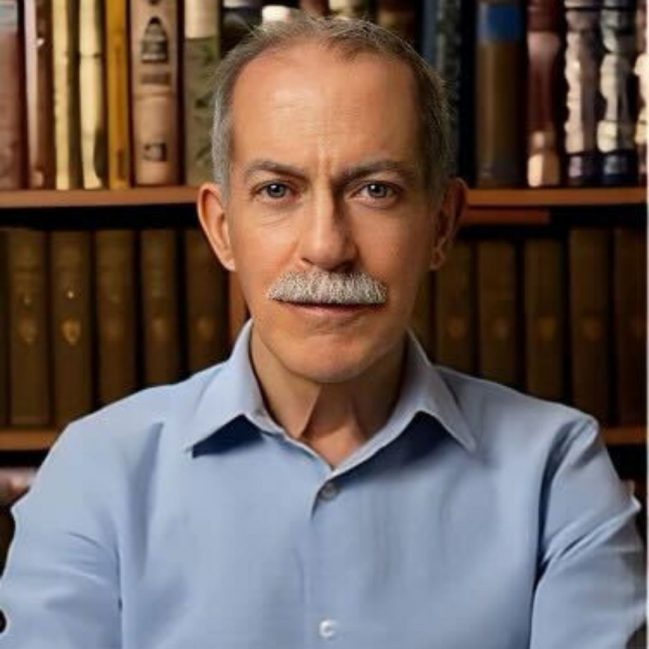
Peter Gribble
The central premise of The City of the Magicians asks whether a pacifist society can survive a violent threat. What first drew you to explore that question in a fantasy setting?
Thousands of little white crosses stretching to the horizon shocked me, a nine-year-old boy, visiting the WWII memorial sites in Normandy. It was my second summer in France and I attended an international French school for NATO and diplomatic corps kids. First day at school, my mother firmly told me, “There was a war. Germany lost. You do not talk about it.” It was a schoolyard courtesy. So I was unprepared for Normandy’s vast acreage of commemorated death. An inarticulate outrage woke in me that day and I was never the same.
Once back in Canada, I read up on the wars and researched the pacifist movement Mahatma Gandhi started, which Dr. Martin Luther King Jr. further developed. The more I studied, the more my sympathy for pacifism grew, but doubts mounted as well. My cautions needed exercise. Decades would pass before I ever considered writing about it, but the visit to Normandy was the seed for The City of the Magicians.
A fantasy setting permitted a broader freer exploration of the pacifist-society-facing-an-invasion idea. Most Citizens of the City inherently understand that the magical dynamic of daily existence supports a pacifistic outlook, but feeling complacent and comfortable, few see the need to observe or practice this more than superficially. As crises metastasize over the three books, some Citizens grow aware that something larger has been gestating all along.
The series avoids many traditional fantasy tropes, focusing more on strategy, culture, and social change than epic battles. Was that a conscious decision from the beginning?
Yes! From the beginning, I wanted to avoid traditional tropes such as the Hero’s Journey and epic quests and battles. So, I thought, The City is the journey’s end! Quests and battles are done! You’re home! Yet when the visitors are Purdu the barbarian and his invasion forces, how long can this civic tradition hold up? The battles end up being for hearts and minds, not for glory on the field. Shoan, the City Council Strategist, resorts to manipulations, prevarications, manoeuvres, and feints—tools that can compromise the very integrity he hopes to preserve.
Throughout the books, plans frequently unravel because of unforeseen events. Do you see uncertainty and unintended consequences as one of the series’ major themes?
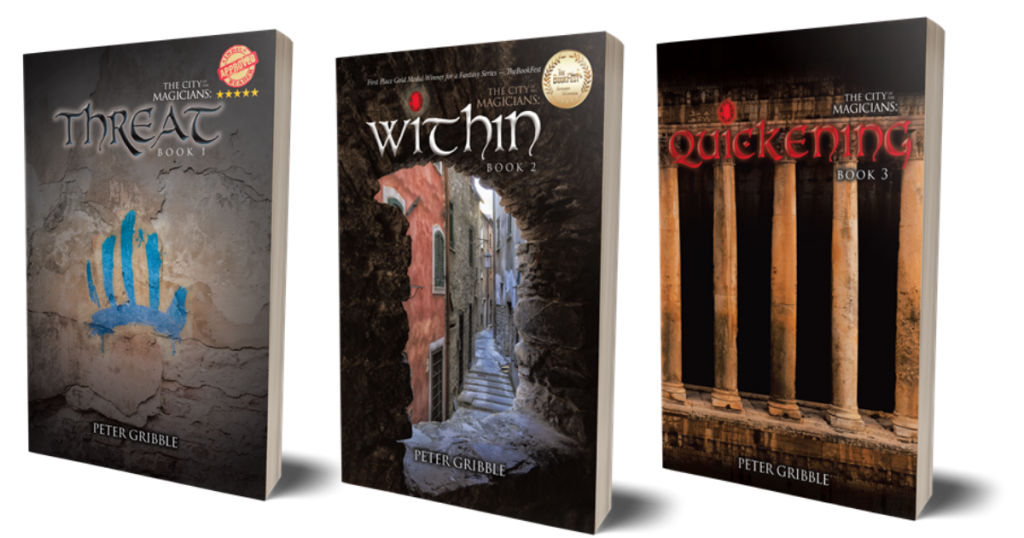
Yes, absolutely! It is an aspect of existence that we tend to ignore or adapt to without exploring its underpinnings. As the story grew, there was no need to map it out. It was a regular pulse of surprise and suspense, revelation and reversal as the City and the characters undergo a gradual, imperceptible maturation (as did I the writer!) There are clues along the way. Some are spotted, many are missed. As the denouement at the end of Quickening approaches, Sas, the main protagonist, and one other begin to glimpse what’s truly happening.
The City of the Magicians feels like a living society with its own history, institutions, and internal conflicts. How much worldbuilding existed before you began writing, and how much emerged during the process?
Long before City, facts and ideas accumulated over the years for no particular reason except I found them interesting: Ottoman love poetry, medical oddities, curses in dead languages, a medieval recipe for eels, the Black Prince’s Ruby, Madame de Sévigné’s letters to her daughter, and so forth. These were real stories, true events, actual practices from a broad range of sources. It is a wide, ever-growing, loose assemblage of quirky facts without a central theme. When City sprang to life, it drew on this cluttered library and quickly possessed a cultural mass that was surprisingly present and immediate. I drew maps, invented their glyphic script, and created family histories. Writing improved the information. Items became essential plot devices, spawning fresh arcs. As the story unfolded, everything drew together into a living, seamless whole. This process continues as I work on the second trilogy of the series. Details spontaneously emerge, fitting naturally into place as if tailor-made. It’s like a jigsaw puzzle with ever-multiplying pieces and no photo on the front of the box for guidance. For me, this is creativity at its mysterious best.
An example: a brief paragraph and illustrations in a high school introductory book on astronomy showed how the skies could be measured with your fists and fingers—astronomy without telescopes. The idea sat in the back of my mind for years until City was born and it neatly delineated the City’s level of technology, roughly equivalent to the late Middle Ages or early Renaissance. From there, a long plot arc sprang fully formed where Gleswea, the City astronomer, would travel south to view skies she’s never seen before. It sets her destiny and changes her life and the life of an entire people.
You have described writing as a process of listening to your characters. Was there a moment in the trilogy when a character took the story somewhere you hadn’t originally intended?
Yes. In book 1, Threat, Sas discovers how badly he’s been manipulated and is about to go up to his rooms and sulk, when out of the blue a voice wrote itself onto the page: “Sas!” called a familiar voice from above. “Come up and have your meal in my rooms. I wish to talk to you.” It was his aunt. I always knew she had a part to play but she inserted herself right then and there, piling more responsibilities and expectations on poor Sas, making that chapter a much better read than I had planned. There was no room for solitary sulking!
Even more startling was when the writing grabbed me by the throat and told me to write something completely different. When I was sketching out the final chapter of Quickening, wrapping up the loose ends: the baby is safely delivered, the wedding goes off without a hitch, everyone comes home and all is well. Once mapped out, my little writing voice said, “Now that you’ve got that out of your system: write this!” I incandesced into a blaze of writing that possessed me in a ten-hour blitz of creativity—no breaks. I was beside myself, laughing, excited, and thrilled by this extraordinary final chapter, which was nothing I had ever imagined. Once done it was obvious the entire manuscript had to be yanked up to the standard of the chapter that had just landed on the page. This took an additional five years.
Do you have plans for future books you’d like to share?
Absolutely! After the last line of Quickening’s final chapter wrote itself, it was clear there were more books in the series, something I had never considered! I’m currently working on the second trilogy: books 4, 5, and 6!
What was the most important thing you learned through self publishing with Tellwell?
There are many important things I learned publishing with Tellwell. I spent roughly five years writing query letters to literary agents in North America and the UK with scarcely a nibble in reply. The self-publishing option made me leery. There were many companies out there, but most were coy about revealing themselves or their costs. Tellwell was the exception. Everything was upfront. Tellwell’s website displayed bios and pics of their team in all departments, an impressive range of talent and experience. Tellwell being located in Victoria, British Columbia, just across the water from Vancouver where I live was an instant plus! I took the ferry over to verify these remarkable people existed and met Simon Ogden, the man I very much wanted to edit City. The item in his bio that hooked me was that his father had an enormous collection of foreign language dictionaries—as do I! I’ve mentioned this before in a previous interview, but Simon’s guidance through the editing process was a masterclass in writing!
To summarize: First day in Grade 9 English class (Thank you, Mrs. King-Aboud!) I knew I was a writer, but Tellwell turned me into a published award-winning author. I am humbled by the achievement and deeply grateful to all the people along the way who helped make it possible.
For more on Peter Gribble and his books
visit his official website.